

-
1 drafting zone
зона вытягивания
Расстояний между линиями зажима волокнистого продукта в вытяжных парах.
Примечания
1. Расстояние между линиями зажима продукта в питающей и выпускной вытяжных парах называется общей зоной вытягивания - А.
2. Расстояние между линиями зажима продукта двух рядом расположенных вытяжных пар называется частной зоной вытягивания.
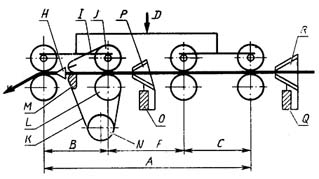
A - общая зона вытягивания; В - главная зона вытягивания; С - зона предварительного вытягивания; D - нагрузка на нажимные валики; F - зона уплотнения; H - передний уплотнитель; I - верхний ремешок. J - ведущий валик верхнего ремешка; К - нижний ремешок; L - цилиндр привода ремешков; М - направляющая нижнего ремешка; N - натяжное устройство нижнего ремешка; О - направляющая для крепления среднего уплотнителя; Р - средний уплотнитель; Q - направляющая для крепления питающей воронки; R - питающая воронка.
[ ГОСТ 28834-90( ИСО 2205-75)]Тематики
EN
DE
FR
Англо-русский словарь нормативно-технической терминологии > drafting zone
-
2 drafting zone
Текстиль: зона вытягивания -
3 drafting zone
Англо-русский словарь текстильной промышленности > drafting zone
-
4 roller drafting zone
-
5 back drafting zone
• esivenytysvyöhyke -
6 two-zone high drafting
English-Russian dictionary on textile and sewing industry > two-zone high drafting
-
7 Fairbairn, Sir Peter
SUBJECT AREA: Textiles[br]b. September 1799 Kelso, Roxburghshire, Scotlandd. 4 January 1861 Leeds, Yorkshire, England[br]British inventor of the revolving tube between drafting rollers to give false twist.[br]Born of Scottish parents, Fairbairn was apprenticed at the age of 14 to John Casson, a mill-wright and engineer at the Percy Main Colliery, Newcastle upon Tyne, and remained there until 1821 when he went to work for his brother William in Manchester. After going to various other places, including Messrs Rennie in London and on the European continent, he eventually moved in 1829 to Leeds where Marshall helped him set up the Wellington Foundry and so laid the foundations for the colossal establishment which was to employ over one thousand workers. To begin with he devoted his attention to improving wool-weaving machinery, substituting iron for wood in the construction of the textile machines. He also worked on machinery for flax, incorporating many of Philippe de Girard's ideas. He assisted Henry Houldsworth in the application of the differential to roving frames, and it was to these machines that he added his own inventions. The longer fibres of wool and flax need to have some form of support and control between the rollers when they are being drawn out, and inserting a little twist helps. However, if the roving is too tightly twisted before passing through the first pair of rollers, it cannot be drawn out, while if there is insufficient twist, the fibres do not receive enough support in the drafting zone. One solution is to twist the fibres together while they are actually in the drafting zone between the rollers. In 1834, Fairbairn patented an arrangement consisting of a revolving tube placed between the drawing rollers. The tube inserted a "middle" or "false" twist in the material. As stated in the specification, it was "a well-known contrivance… for twisting and untwisting any roving passing through it". It had been used earlier in 1822 by J. Goulding of the USA and a similar idea had been developed by C.Danforth in America and patented in Britain in 1825 by J.C. Dyer. Fairbairn's machine, however, was said to make a very superior article. He was also involved with waste-silk spinning and rope-yarn machinery.Fairbairn later began constructing machine tools, and at the beginning of the Crimean War was asked by the Government to make special tools for the manufacture of armaments. He supplied some of these, such as cannon rifling machines, to the arsenals at Woolwich and Enfield. He then made a considerable number of tools for the manufacture of the Armstrong gun. He was involved in the life of his adopted city and was elected to Leeds town council in 1832 for ten years. He was elected an alderman in 1854 and was Mayor of Leeds from 1857 to 1859, when he was knighted by Queen Victoria at the opening of the new town hall. He was twice married, first to Margaret Kennedy and then to Rachel Anne Brindling.[br]Principal Honours and DistinctionsKnighted 1858.Bibliography1834, British patent no. 6,741 (revolving tube between drafting rollers to give false twist).Further ReadingDictionary of National Biography.Obituary, 1861, Engineer 11.W.English, 1969, The Textile Industry, London (provides a brief account of Fairbairn's revolving tube).C.Singer (ed.), 1958, A History of Technology, Vols IV and V, Oxford: Clarendon Press (provides details of Fairbairn's silk-dressing machine and a picture of a large planing machine built by him).RLH -
8 Casablancas, Fernando
SUBJECT AREA: Textiles[br]fl. 1912 Spain[br]Spanish inventor of the first of the high-draft cotton-spinning systems.[br]In 1912, Casablancas took out three patents in Britain. The first of these was for putting false twist into textile fibres during the drawing part of spinning. In his next we can find the origins of his interest in his high-draft system, for it contains intermediate sectors or rollers between the usual drawing rollers. It was not until the third patent that there appeared the basis of the modern system with endless inextensible strips of material passing round the rollers to help support the fibres. His first system was for spinning fibres of medium length, giving a much greater draft. This consisted of two aprons around the middle pair of drafting rollers which reached almost to the front ones. The aprons lightly pressed the fibres together in the drafting zone and yet allowed the more-quickly rotating front rollers to pull fibres out of the aprons quite easily. This enabled slivers or rovings to be reduced in thickness more quickly and evenly. In 1913, a further patent showed a development of the apron system where guides made the aprons move in an "S" pattern. Then in 1914 a patent illustrated something similar to the modern layout, while two further patents in the following year contained slightly different layouts. His system was soon applied to both ring frames and the mule, and while it was first applied to cotton, it soon spread to worsted. High-draft spinning was also envisaged by Casablancas and he took out a further patent in 1920 to obtain drafts in a ratio of several hundreds. His principles are used today on some of the most recent open-end spinning frames.[br]Bibliography1912, British patent no. 11,376 (textile fibres with false twist). 1912, British patent no. 11,783.1912. British patent no. 12,477.1913. British patent no. 11,613.1914. British patent no. 19,372 1915. British patent no. 3,366.1915, British patent no. 14,228.Further ReadingC.Singer (ed.), 1978, A History of Technology, Vol. 6, Oxford: Clarendon Press (mentions his spinning methods).RLH -
9 Highs, Thomas
SUBJECT AREA: Textiles[br]fl. 1760s England[br]English reedmaker who claimed to have invented both the spinning jenny and the waterframe.[br]The claims of Highs to have invented both the spinning jenny and the waterframe have been dismissed by most historians. Thomas Highs was a reedmaker of Leigh, Lancashire. In about 1763 he had as a neighbour John Kay, the clockmaker from Warrington, whom he employed to help him construct his machines. During this period they were engaged in making a spinning jenny, but after several months of toil, in a fit of despondency, they threw the machine through the attic window. Highs persevered, however, and made a jenny that could spin six threads. The comparatively sophisticated arrangements for drawing and twisting at the same time, as depicted by Guest (1823), suggest that this machine came after the one invented by James Hargreaves. Guest claims that Highs made this machine between 1764 and 1766 and in the following two years constructed another, in which the spindles were placed in a circle. In 1771 Highs moved to Manchester, where he constructed a double jenny that was displayed at the Manchester Exchange, and received a subscription of £200 from the cotton manufacturers. However, all this occurred after Hargreaves had constructed his jenny. In the trial of Arkwright's patent during 1781, Highs gave evidence. He was recalled from Ireland, where he had been superintending the building of cotton-spinning machinery for Baron Hamilton's newly erected mill at Balbriggan, north of Dublin. Then in 1785, during the next trial of Arkwright's patent, Highs claimed that in 1767 he had made rollers for drawing out the cotton before spinning. This would have been for a different type of spinning machine, similar to the one later constructed by Arkwright. Highs was helped by John Kay and it was these rollers that Kay subsequently built for Arkwright. If the drawing shown by Guest is correct, then Highs was working on the wrong principles because his rollers were spaced too far apart and were not held together by weights, with the result that the twist would have passed into the drafting zone, producing uneven drawing.[br]Further ReadingR.Guest, 1823, A Compendious History of the Cotton-Manufacture: With a Disproval of the Claim of Sir Richard Arkwright to the Invention of its Ingenious Machinery, Manchester (Highs's claim for the invention of his spinning machines).R.S.Fitton, 1989, The Arkwrights, Spinners of Fortune, Manchester (an examination of Highs's claims).R.L.Hills, 1970, Power in the Industrial Revolution, Manchester (discusses the technical problems of the invention).RLH
См. также в других словарях:
Drafting (aerodynamics) — A paceline of drafting cyclists For other uses, see Slipstream (disambiguation). Drafting or slipstreaming is a technique where two vehicles or other moving objects are caused to align in a close group reducing the overall effect of drag due to… … Wikipedia
Drafting water — Fire engine drafting The term drafting water refers to the use of suction to move a liquid such as water from a vessel or body of water below the intake of a suction pump. A rural fire department or farmer might draft water from a pond as the… … Wikipedia
Drafting — Belgischer Kreisel im Radsport Beim Drafting wird im Sport versucht, durch permanenten Wechsel bei der Führungsarbeit den Widerstand zu minimieren. Dies kommt immer wieder bei Ausdauersportarten, wie Radfahren (z. B. Technik des Belgischen… … Deutsch Wikipedia
African Nuclear Weapons Free Zone Treaty — The African Nuclear Weapon Free Zone Treaty, also known as the Treaty of Pelindaba, establishes a Nuclear Weapon Free Zone in Africa. Signature of the Treaty culminates a 32 year quest for a nuclear free Africa, beginning when the Organization of … Wikipedia
Fremantle Football Club drafting and trading history — Fremantle Football Club s drafting and trading history is often cited as a reason for their poor on field record, in not winning a finals game in their first 11 seasons. This can also be coupled to the few concessions that they received relative… … Wikipedia
зона вытягивания — Расстояний между линиями зажима волокнистого продукта в вытяжных парах. Примечания 1. Расстояние между линиями зажима продукта в питающей и выпускной вытяжных парах называется общей зоной вытягивания А. 2. Расстояние между линиями зажима продукта … Справочник технического переводчика
Glossary of bicycling — The following terminology is used in the general cycling, as well as the more specific sports of road bicycle racing and mountain bicycle racing. Contents: Top · 0–9 · A B C D E F G H I J K L M N O P Q R S T U V W … Wikipedia
France — /frans, frahns/; Fr. /frddahonns/, n. 1. Anatole /ann nann tawl /, (Jacques Anatole Thibault), 1844 1924, French novelist and essayist: Nobel prize 1921. 2. a republic in W Europe. 58,470,421; 212,736 sq. mi. (550,985 sq. km). Cap.: Paris. 3.… … Universalium
Myanmar — /muy ahn mah/, n. Union of, official name of Burma. * * * I or Burma officially Union of Myanmar Country, Southeast Asia, on the Bay of Bengal and the Andaman Sea. Area: 261,228 sq mi (676,577 sq km). Population (2002 est.): 42,238,000. Capital:… … Universalium
Bicycling terminology — The following terminology is used in the general cycling, as well as the more specific sports of road bicycle racing and mountain bicycle racing.AalleycatA bicycle race typically organized by bicycle messengers or couriers. Alleycat races seek to … Wikipedia
china — /chuy neuh/, n. 1. a translucent ceramic material, biscuit fired at a high temperature, its glaze fired at a low temperature. 2. any porcelain ware. 3. plates, cups, saucers, etc., collectively. 4. figurines made of porcelain or ceramic material … Universalium
